
System design interview preparation with a real-time copilot helper
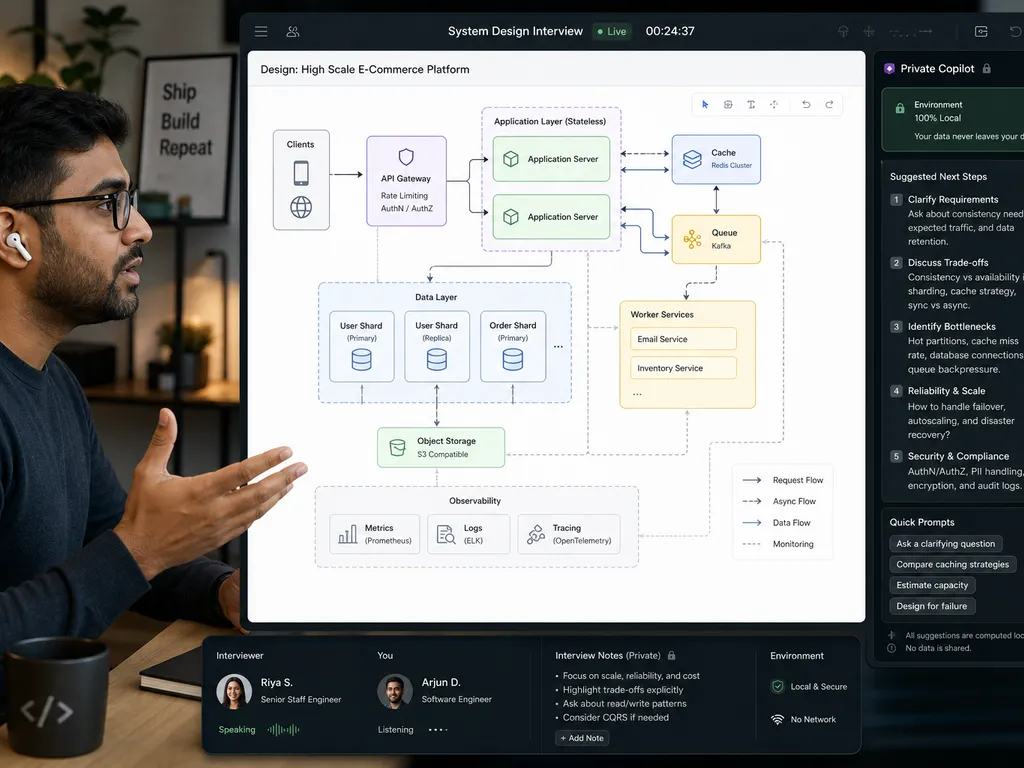
System design interview preparation gets better when we practice the exact behaviors the interview demands: structured thinking, clear tradeoff analysis, calm communication, and rapid recovery when pressure spikes. A real-time copilot helper supports that loop by reducing setup friction, keeping guidance private, and helping candidates rehearse architecture decisions in a live, technical environment.
We see the same pattern across technical hiring. Strong developers often know the fundamentals but still underperform in system design rounds because the format is noisy. They juggle requirements, scale assumptions, API contracts, data models, bottlenecks, and interviewer signals at the same time. System design interview preparation should train that multitasking directly, not just review diagrams in isolation.
That is where a real-time copilot helper changes the workflow. Instead of static notes or passive reading, we can simulate active interview conditions. We can pressure-test a candidate’s framing, identify weak spots in caching or partitioning logic, and reinforce a tighter communication style while the session is still unfolding. For hiring teams, this also means less ambiguity around readiness and less dependence on inconsistent mock interview quality.
Why system design interview preparation breaks down under live pressure
Most candidates do not fail because they lack technical ability. They fail because their system design interview preparation was too detached from the interview reality. In a real session, there is little time to search memory, reorganize thoughts, and translate knowledge into a coherent design story. The candidate must move from vague prompt to architecture, from architecture to tradeoffs, and from tradeoffs to defense.
We design system design interview preparation around those transition points. The challenge is rarely just choosing a message queue or a database. The challenge is sequencing decisions in a way that sounds deliberate. Good candidates clarify constraints early. Great candidates do it while staying relaxed, adaptive, and concise.
Live coding pressure and system design pressure also overlap more than many teams admit. Both create cognitive overload. Both expose communication gaps. Both punish messy environments and unstable tooling. Add candidate anxiety, awkward screen sharing, and concern about where data is stored, and preparation quality drops fast.
How a real-time copilot helper improves system design interview preparation
A real-time copilot helper adds support at the moment it matters most: during the exercise itself. We use it to keep candidates focused on the design path instead of getting lost in blank-page hesitation. The goal is not to replace thinking. The goal is to sharpen it in real time.
For system design interview preparation, that means the helper can reinforce a repeatable pattern. Start with scope. Clarify traffic, latency, consistency, and failure tolerance. Define core entities. Sketch read and write flows. Identify scaling risks. Propose mitigations. Revisit tradeoffs. Candidates who practice this loop repeatedly develop speed without sounding scripted.
- Prompt better requirement clarification at the start of the session
- Surface missing assumptions around scale, availability, and consistency
- Encourage explicit tradeoff language instead of vague design claims
- Reduce setup friction so practice time is spent on architecture, not tools
- Keep support local and privacy-first for sensitive interview preparation
That privacy-first point matters. Technical interviews often involve proprietary thinking patterns, candidate recordings, and employer-specific evaluation criteria. We built our approach around local-data handling because system design interview preparation should feel safe enough for honest rehearsal. When candidates trust the environment, they speak more naturally, take more risks, and improve faster.
A practical framework for system design interview preparation
We recommend a preparation model that mirrors the actual interview lifecycle. System design interview preparation works best when candidates stop treating the round as a trivia test and start treating it as a decision narrative. The interviewer is listening for reasoning quality, not just component names.
1. Frame the problem before drawing
We coach candidates to open with constraints, not boxes and arrows. A rushed diagram often hides a weak understanding of the ask. In system design interview preparation, the first minutes should establish users, traffic shape, read-write patterns, latency targets, data retention, and operational priorities.
2. Build the simplest viable architecture first
Candidates often overdesign too early. We push for a compact baseline architecture that clearly satisfies the core use case. Then we scale it. This approach makes system design interview preparation more resilient because it teaches candidates how to layer sophistication instead of dumping complexity all at once.
3. Make tradeoffs explicit
A strong answer is full of decision language. Why choose eventual consistency here? Why isolate writes? Why cache at this layer? Why shard by tenant versus region? In system design interview preparation, we drill verbal tradeoffs until they become instinctive. Silence around tradeoffs usually signals shallow understanding.
4. Design for failure, not just throughput
Interviewers listen carefully for fault tolerance. We train candidates to discuss retries, idempotency, backpressure, failover, queue buildup, hot partitions, and degraded modes early. This is where system design interview preparation separates competent candidates from senior-level candidates.
5. Close with bottlenecks and next iterations
A polished candidate ends by identifying current limits and proposing the next scaling step. That finish shows judgment. It turns system design interview preparation into a disciplined habit of reflection instead of a rushed sprint to fill the whiteboard.
System design interview preparation for candidates under anxiety and time pressure
Candidate anxiety is not a side issue. It changes recall, pacing, and confidence. We account for that directly in system design interview preparation by making practice feel live, technical, and contained. The helper can keep the session moving when a candidate stalls, but without taking over the answer.
This matters for communication quality. Under pressure, candidates often jump between unrelated layers of the stack. They mention Kafka before defining the write path. They discuss replication before naming the core entity model. They skip the API surface entirely. System design interview preparation with real-time support helps restore order when nerves disrupt sequencing.
- Use timed drills to normalize compression of thought
- Rehearse requirement gathering until it becomes automatic
- Practice recovery phrases for when assumptions change midstream
- Train concise summaries after each major design decision
- Keep the environment private so candidates can practice without self-censorship
The outcome is not just better answers. It is steadier performance. That consistency is what hiring teams want and what candidates need.
What hiring teams gain from better system design interview preparation
System design interview preparation is not only a candidate concern. Employers also pay for weak preparation through false negatives, inconsistent signal, and longer hiring cycles. When interview support is structured and real time, hiring teams get clearer evidence of how a candidate thinks through ambiguity.
We have found that strong preparation improves the interview on both sides. Candidates arrive with a clearer method. Interviewers spend less time pulling structure out of the conversation. Evaluation becomes more about seniority, tradeoff judgment, and architecture depth than about who handles stress theatrically.
A privacy-first local approach also reduces internal friction. Teams are rightly cautious about sending interview content, code, or candidate data into systems they cannot control. For system design interview preparation, local-data handling supports adoption because it aligns with how technical organizations think about confidentiality.
Choosing the right real-time workflow for system design interview preparation
The best workflow is the one that feels invisible during the session. If the helper creates distraction, it fails. We believe system design interview preparation should preserve the natural cadence of an interview while quietly improving structure, recall, and confidence.
That means the workflow should be fast to launch, easy to follow, and technically relevant. Candidates need support that understands architecture conversations, not generic productivity advice. Hiring teams need signals that map to real interview rubrics: scoping, decomposition, scaling, reliability, and communication.
Our view is simple. System design interview preparation should happen in the same conditions where candidates are judged. Live. Technical. Private. Grounded in real constraints. A real-time copilot helper is valuable because it reinforces good decision habits while the conversation is still alive.
FAQ
How does a real-time copilot helper support system design interview preparation?
It supports system design interview preparation by guiding structure in the moment. We can reinforce requirement gathering, tradeoff analysis, failure planning, and concise communication while a mock or live session is happening.
Is system design interview preparation better with live practice than with notes alone?
Yes. Notes help with recall, but system design interview preparation improves faster when candidates practice speaking, sequencing decisions, and handling interruptions under time pressure.
Why does privacy matter in system design interview preparation?
System design interview preparation often includes sensitive candidate data, employer-specific prompts, and proprietary technical discussion. A privacy-first, local-data workflow helps teams and candidates practice with less risk and more confidence.
What should candidates focus on first during system design interview preparation?
They should focus on clarifying scope and constraints first. Strong system design interview preparation starts with requirements, traffic assumptions, data shape, and success criteria before any detailed architecture is proposed.
Can system design interview preparation reduce candidate anxiety?
Yes. Good system design interview preparation reduces uncertainty by giving candidates a repeatable method. Real-time support also helps them recover from stalls, organize thoughts, and maintain momentum during high-pressure technical interviews.